
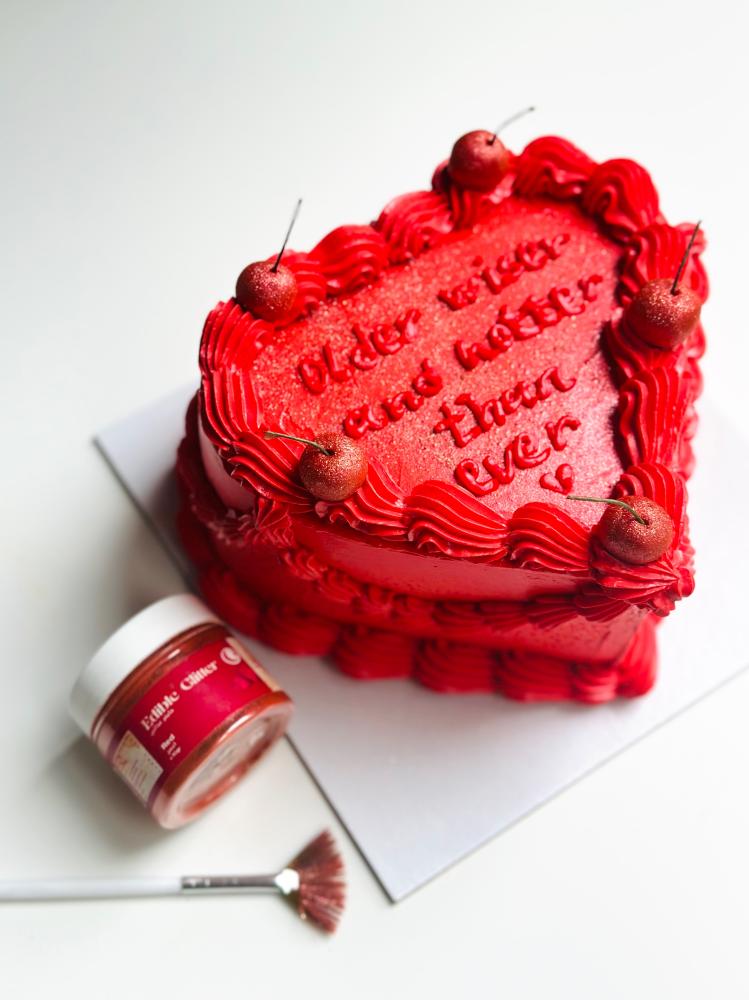
Glittering icing materials have become an essential part of the cake and dessert world, especially when aiming to add a touch of luxury or a dazzling, eye-catching effect. Among the most popular of these products are Edible Metallic Dust and Edible Glitter . While both are used to add shine, there is a clear difference between them in terms of appearance, application, and final result.
What is Edible Metallic Dust?
Edible Metallic Dust , or edible metallic powder , is a very fine powder intended for food use, and is used to give the surface of sweets a shiny metallic appearance, such as gold, silver, or bronze.
This type is characterized by the smoothness of its grains, so the result is closer to a uniform metallic coating and not separate shiny grains.
It can be applied dry with a suitable brush for light touches, or, in some products, mixed with a food-grade liquid medium and then brushed on for a more pronounced metallic finish. It is commonly used on sugar paste, chocolate, sugar decorations, and other confectionery embellishments.
What is Edible Glitter?
Edible Glitter , or edible glitter , is a glittery food product designed to give a sparkling, shimmering effect.
Unlike metallic powder, glitter typically has a more pronounced effect in terms of shimmering dots or flakes that reflect light . Therefore, it's suitable when the goal is to add eye-catching sparkle to the surface of cakes, cupcakes, donuts, chocolates, and other desserts.
The size and shape of glitter particles vary from product to product; some types are very fine, while others are larger and more visible.
What is the difference between them?
The main difference lies in the type of final effect .
If a smooth, gold or silver surface resembling polished metal is desired, Edible Metallic Dust is the product that gives this type of appearance.
If what is required is a clear, multi-reflective glitter, so that the glitter particles appear on the surface of the candy, then Edible Glitter is the most suitable for this effect.
In simple terms:
Metallic Dust = A smooth, uniform metallic effect.
Edible Glitter = A sparkling and glittering effect with visible particles.
It is possible to use the two products together in the same design; for example, one of the decorations can be covered with gold powder to get a metallic base, then a small amount of edible glitter can be added to highlight certain areas and increase the sparkle.
Important point: the word Edible
When purchasing any glitter or shimmer powder for direct application to food, ensure that the packaging clearly states that it is Edible (food-safe ), and not just Non-Toxic (non-toxic) .
The labeling of a product as “non-toxic” does not necessarily mean it is intended for consumption as food. Therefore, it is important to read the label, the ingredients list, and the manufacturer's instructions to ensure the product is indeed intended for food use, especially when applied to portions of candy that will be eaten.
Summary
Although Edible Metallic Dust and Edible Glitter both add shine to sweets, they serve different aesthetic functions. Metallic dust gives sweets a smooth, luxurious metallic look , while edible glitter provides a clear, sparkling shine .